
October 31, 2026
By RVR Associates | Intellectual Property Rights
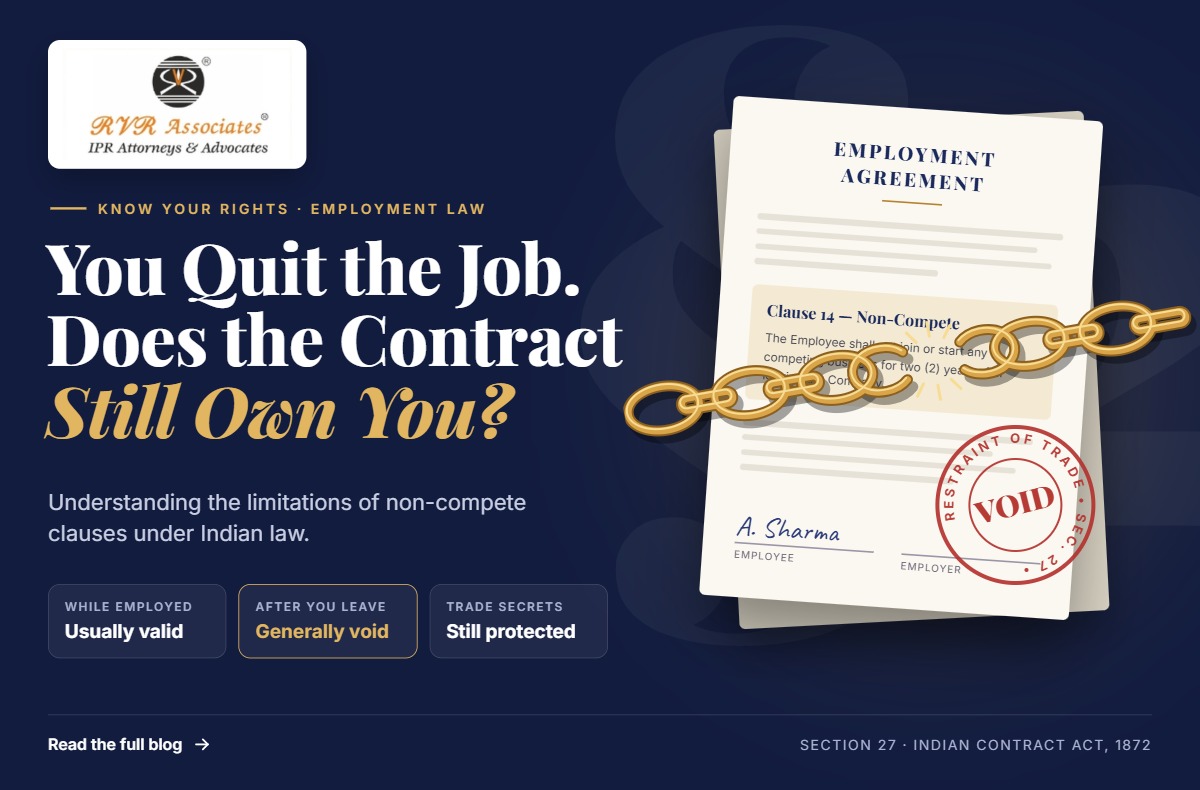
Upon receiving a job offer, you may notice a clause stating that you cannot join a competitor for two years following your departure. While this appears to be a binding commitment, its enforceability under Indian law depends primarily on the timing of the restriction.
Why is India’s legal approach distinct?
The governing principle is Section 27 of the Indian Contract Act, 1872, which stipulates that any agreement restraining an individual from pursuing a lawful profession, trade, or business is void, with the sole exception being the sale of business goodwill. Unlike jurisdictions such as the US or UK, India does not apply a “reasonableness” test to post-termination restrictions, meaning a seemingly fair clause may still be legally invalid.
Can a company prohibit you from working elsewhere during your employment?
Yes. Restrictions during the period of employment are not viewed as restraints of trade but as a means to ensure professional commitment. Established by the 1967 Niranjan Shankar Golikari case, this remains a valid legal position, and engaging in secondary employment with a rival while on the payroll may result in significant consequences.
What about restrictions after employment ends?
This is where most non-compete clauses are unenforceable. In the case of Krishan Murgai, the Supreme Court ruled that a post-employment clause preventing an employee from accepting similar work is void, regardless of the duration or geographic scope of the restriction. Similarly, in Varun Tyagi v. Daffodil Software, the Delhi High Court held that such clauses are void, noting that employers may only restrict the misuse of confidential information or client solicitation, rather than using confidentiality as a pretext for restricting professional mobility.
Comparing outcomes
If an employee is prohibited from working for a competitor while currently employed, that clause is enforceable. Conversely, if an employee joins a competitor after resigning, a non-compete clause spanning two years is likely void. However, this does not grant the former employee the right to misappropriate client lists or trade secrets. It is important to remember that signing an agreement does not validate an illegal restraint, nor does the invalidity of a clause authorize the unauthorized use of protected information.
The broader perspective: what protections remain for employers?
Even if a non-compete clause is void, employers retain legal protections regarding confidential or proprietary information. Confidentiality obligations and trade secret protections remain in effect, and non-solicitation clauses require more nuanced drafting than general non-competes. Furthermore, employers have legitimate options available during the notice period.
As the employee remains under contract, the non-compete clause continues to apply throughout the garden leave period. Business arrangements differ as well; the analysis shifts when the context moves from employment to commercial transactions, such as the sale of a business or a shareholder agreement. One related area involves the minimum-service bond. In the case of Vijaya Bank v. Prashant Narnaware (2025), the Supreme Court upheld an employment bond requiring liquidated damages if the employee failed to complete a minimum service period, while noting that the ruling should not be considered definitive for all cases.
If you are signing an employment contract, please consider the following questions first. Does the restriction apply during employment or after it ends? Is it truly a non-compete, or is it a confidentiality or non-solicitation clause? Does it mention a notice period or garden leave? Is there a service bond or penalty for leaving early? Would I be taking confidential data, client lists, or documents with me upon departure?
If you are an employee, please take steps to protect yourself. Read all restrictive clauses thoroughly before signing and inquire about the scope of each one. Keep your personal files separate from your work files. Refrain from taking confidential material when you leave, even if the non-compete is void. Verify bond terms and notice-period rules prior to resigning. If you receive a legal notice, maintain detailed records and seek professional advice promptly.
Ultimately, where is the line drawn? In India, a non-compete clause during employment is generally acceptable, but a post-employment restriction is typically void. While protecting confidential information is a legitimate goal, preventing an individual from earning a livelihood is not. The law is designed to safeguard an employer’s secrets rather than restrict an employee’s career.
Key Case References:
1. Niranjan Shankar Golikari v. Century Spinning (1967), AIR 1967 SC 1098 — Upheld certain negative covenants operating during employment.
2. Superintendence Company of India v. Krishan Murgai (1981), (1981) 2 SCC 246 — Examined post-employment restraints under Section 27 of the Indian Contract Act.
3. Percept D’Mark v. Zaheer Khan (2006), (2006) 4 SCC 227 — Reaffirmed restrictions on post-contractual restraints of trade.
4. Varun Tyagi v. Daffodil Software (Delhi High Court, 2025) — Addressed post-employment restrictions and an employee’s freedom to take up new employment.
5. Vijaya Bank v. Prashant B. Narnaware (2025), 2025 INSC 691 — Upheld a minimum-service bond with liquidated damages in the circumstances of the case.
Author by,
RVR Attorneys Associates