
October 23, 2026
By RVR Associates | Intellectual Property Rights
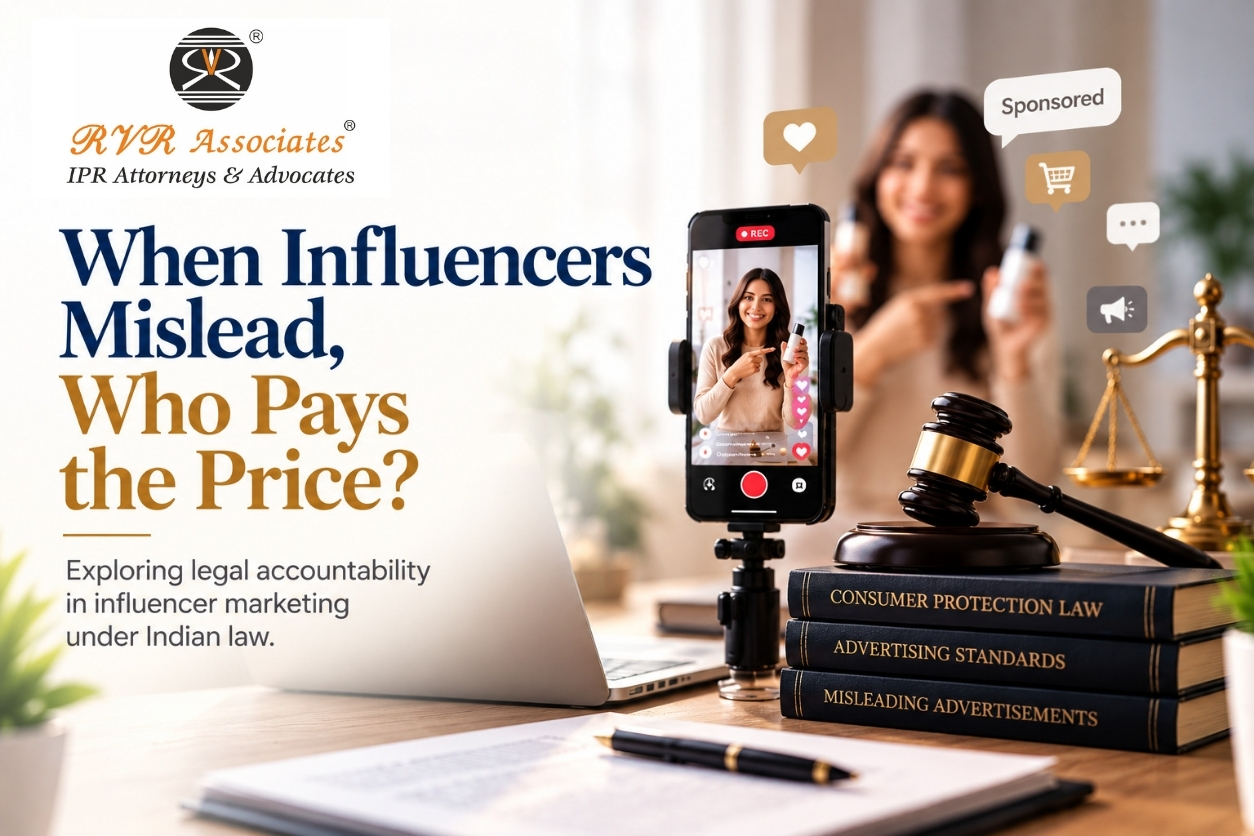
There was a time when influencers primarily shared personal recommendations. Today, a single video can lead to an immediate sell-out of a product, demonstrating the speed and effectiveness of this marketing style.
However, when a product fails to meet expectations, a complex question arises regarding whether the brand or the influencer bears responsibility.
Under Indian law, both parties may be held accountable.
Can an influencer be held liable?
Yes, an influencer may be classified as an endorser within India’s consumer protection framework, and even casual posts are considered advertisements.
The Consumer Protection Act, 2019 serves as the foundation by defining misleading advertisements and extending liability to endorsers. Furthermore, the 2022 CCPA guidelines clarify that both brands and endorsers can be held jointly responsible for misleading claims.
Follower count is irrelevant, as regulators emphasize that these liability rules apply to all creators regardless of their audience size.
Key legal concepts
- Endorsement (Section 2(18)): The Act defines an endorsement as any message, verbal statement, demonstration or depiction of a person’s name, signature, likeness or other identifiable personal characteristics. Reels, stories, unboxing videos and reviews can all fall within it.
- Misleading advertisement (Section 2(28)): An advertisement that falsely describes a product or service, gives a false guarantee, conveys a representation that would amount to an unfair trade practice, or deliberately conceals important information.
- Unfair trade practice (Section 2(47)): Includes making false or misleading representations about the standard, quality, or benefits of goods or services in order to promote their sale.
- The regulator: The Central Consumer Protection Authority (CCPA), set up under Section 10 of the Act, can investigate misleading advertisements, order them to be withdrawn or modified, and impose penalties on manufacturers and endorsers.
Disclosure rules for creators
The Department of Consumer Affairs issued the Endorsement Know-hows! for celebrities, influencers and virtual influencers in January 2023. Any “material connection” with a brand must be disclosed. This includes payment, free products, discounts, family or employment ties, or any other benefit.
Disclosures must be prominent, in simple language, and placed in the endorsement itself, using terms such as “Advertisement”, “Ad”, “Sponsored”, “Collaboration” or “Paid Promotion”. They must not be hidden among hashtags or links. They must be superimposed on images and shown on screen in videos and live streams.
The ASCI guidelines go into more detail. For example, in videos shorter than 15 seconds, the disclosure label must stay on screen for at least 3 seconds. The platform’s own “Paid Partnership” tag cannot replace a clear disclosure by the creator.
What has the Supreme Court stated?
In the case regarding Patanjali’s misleading advertisements (IMA v. Union of India), Justices Hima Kohli and Ahsanuddin Amanullah asserted that influencers and celebrities must exercise responsibility when promoting products and remain equally accountable for false or misleading content.
Consequently, creators with small audiences are held to the same standard as high-profile film stars.
In its order of 7 May 2024, the Court also directed that advertisers file a self-declaration before an advertisement is released, confirming that it complies with the applicable advertising rules. The case also highlighted the Drugs and Magic Remedies (Objectionable Advertisements) Act, 1954. That law prohibits advertisements claiming that a product can cure certain diseases and conditions. For creators who promote health, wellness or “miracle” products, it adds a further layer of risk.
The same content can carry different levels of risk.
Consider two creators promoting products.
Person A, who has used a face wash for months and provides an honest review with a clear “#ad” disclosure, is operating transparently.
Conversely, Person B, who is paid to promote a supplement he has never used while making unverified “clinically proven” claims, faces potential liability. If these claims are proven false, he has limited protection.
It is important to remember that instructions from a brand do not necessarily constitute a defense, and minor disclosures cannot rectify a fundamentally false claim.
What protections are available to an influencer?
The Act provides a due diligence defense, meaning an endorser is not penalized if they have taken reasonable steps to verify the advertisement’s claims. Additionally, CCPA guidelines stipulate that endorsements should reflect the individual’s genuine experience with the product.
This defence comes from Section 21(5) of the Consumer Protection Act, 2019. Under the CCPA’s Guidelines for Prevention of Misleading Advertisements and Endorsements for Misleading Advertisements, 2022, an endorsement must reflect the endorser’s genuine, reasonably current opinion. The endorser must also have adequate information about, or experience with, the product or service being endorsed.
The penalties are significant. A first violation may result in a fine of up to ₹10 lakh, with subsequent violations reaching up to ₹50 lakh. Furthermore, the CCPA may prohibit an endorser from participating in future endorsements for one to three years, which can be more detrimental to a creator’s career than the monetary fine itself.
Under Section 21, the endorsement ban can last up to one year for a first violation and up to three years for each later one. Separately, Section 89 makes false or misleading advertisements a criminal offence for manufacturers and service providers. This carries imprisonment of up to two years and a fine of up to ₹10 lakh, rising to five years and ₹50 lakh for repeat offences. This is why brands increasingly ask creators to sign detailed agreements.
When preparing a promotion, please consider the following questions.
- Have I personally used this product?
- Can the brand substantiate its claims, and do I possess written confirmation of this evidence?
- Is my disclosure regarding the sponsored nature of the post clear and visible? This information should be included within the endorsement itself.
- Am I making any claims regarding health, finances, or guaranteed results, as these carry the highest risk?
- Does my contract specify who bears the responsibility should a claim prove to be false?
Are you a content creator? Please ensure you protect yourself.
- Maintain thorough records of how you tested the product and what the brand provided to you.
- Request test reports, certifications, or studies prior to posting content.
- Please refrain from repeating claims that you cannot substantiate.
- Include disclosure requirements within your influencer agreements.
- Please also adhere to the ASCI influencer guidelines, which exist because audiences often struggle to distinguish personal posts from paid promotions.
- Consider an indemnity clause in your agreement, under which the brand compensates you if a claim it supplied turns out to be false. Indemnity doesn’t stop the CCPA from acting against you, but it can protect you financially.
- Keep track of the value of products you receive, since gifts above the Section 194R threshold have tax implications.
So, who is held liable?
Frequently, everyone involved. Both the brand that originated the claim and the creator who disseminated it may be held responsible.
The law does not prohibit influencers from promoting products; rather, it requires that they remain honest and diligent when doing so. While social media often makes advertising appear casual, it does not absolve anyone of responsibility, as trust is the foundation upon which the entire industry relies.
Disclaimer: This article is intended for general informational purposes only and does not constitute legal advice. The legal position may depend on the facts of each case and on later judicial or regulatory developments. Please consult a qualified advocate for advice on your specific situation.
References
Statutes and rules
- The Consumer Protection Act, 2019: Sections 2(18), 2(28), 2(47), 10, 21 and 89.
- Guidelines for Prevention of Misleading Advertisements and Endorsements for Misleading Advertisements, 2022: Central Consumer Protection Authority, notified 9 June 2022.
- Endorsement Know-hows! for Celebrities, Influencers and Virtual Influencers on Social Media Platforms: Department of Consumer Affairs, Government of India, January 2023.
- The Drugs and Magic Remedies (Objectionable Advertisements) Act, 1954.
- The Income-tax Act, 1961: Section 194R.
- The Digital Personal Data Protection Act, 2023.
Self-regulatory and regulatory guidelines
- Advertising Standards Council of India (ASCI): Guidelines for Influencer Advertising in Digital Media (2021, updated 2023).
- Securities and Exchange Board of India (SEBI): Circulars on the association of regulated entities with unregistered persons, including finfluencers (2024).
Case law
- Indian Medical Association v. Union of India, Writ Petition (Civil) No. 645 of 2022, Supreme Court of India, including the order dated 7 May 2024.
Author by,
RVR Attorneys Associates