
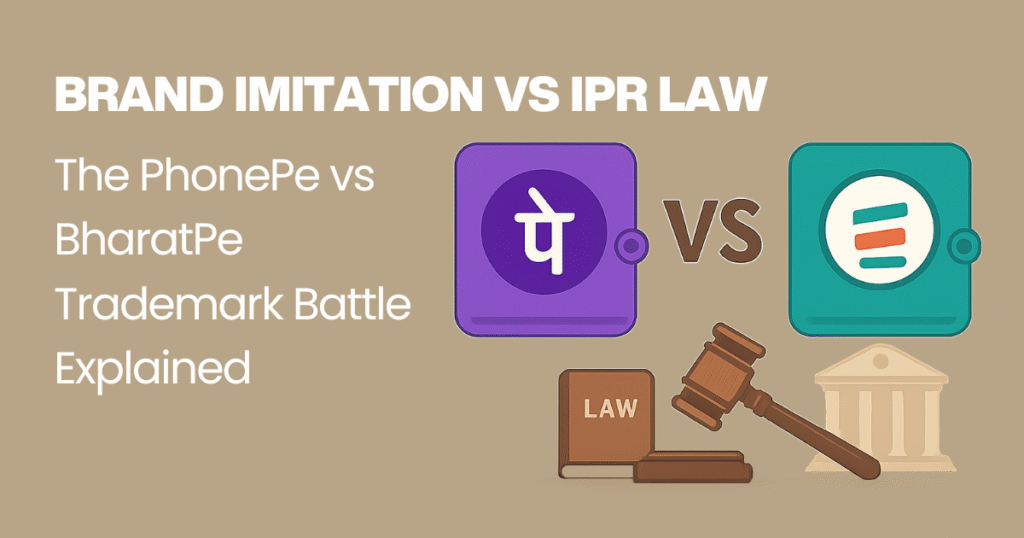
Introduction to the PhonePe vs BharatPe Dispute
The Indian fintech ecosystem witnessed a landmark trademark conflict between PhonePe and BharatPe.
This legal battle reshaped discussions around brand imitation and intellectual property rights.
Moreover, it highlighted how naming strategies can trigger serious legal consequences.
Therefore, understanding this case offers crucial lessons for startups and established brands alike.
Understanding Brand Imitation in Competitive Markets
Brand imitation occurs when a business adopts elements resembling an existing brand.
Such imitation often targets names, logos, colors, or phonetic similarities.
Consequently, consumers may experience confusion or mistaken association.
Hence, trademark law intervenes to protect brand identity and consumer trust.
Overview of Intellectual Property Rights in India
Intellectual Property Rights safeguard creations of the human intellect.
These rights include trademarks, copyrights, patents, and industrial designs.
Specifically, trademark law protects brand names and distinctive identifiers.
As a result, registered owners gain exclusive usage rights within defined categories.
Background of PhonePe and BharatPe Brands
PhonePe entered the digital payments space as a consumer-focused UPI application.
It emphasized simplicity, speed, and mobile-first financial transactions.
In contrast, BharatPe targeted merchants with QR-based payment solutions.
However, both brands operated within overlapping fintech ecosystems.
Why the Trademark Conflict Emerged
The conflict emerged due to phonetic similarity between “PhonePe” and “BharatPe.”
PhonePe argued that the suffix “Pe” created brand confusion.
Additionally, PhonePe claimed prior market presence and trademark recognition.
Therefore, it sought legal protection against perceived imitation.
Key Legal Arguments Presented by PhonePe
PhonePe asserted that its trademark enjoyed strong consumer recall.
Furthermore, it argued that BharatPe deliberately adopted a similar naming pattern.
PhonePe emphasized likelihood of confusion among average users.
Thus, it requested injunctions against BharatPe’s trademark usage.
BharatPe’s Defense and Counterarguments
BharatPe countered by highlighting semantic and visual distinctions.
It explained that “Pe” represents the Hindi word for “on.”
Moreover, BharatPe stressed its merchant-centric positioning.
Hence, it denied any intention of brand imitation.
Court Observations on Trademark Similarity
The court analyzed phonetic, visual, and conceptual similarities.
It observed that both names shared a common suffix.
However, prefixes “Phone” and “Bharat” conveyed distinct meanings.
Therefore, complete consumer confusion appeared less likely.
Judicial Verdict and Its Implications
The court ultimately ruled in favor of BharatPe.
It stated that suffix usage alone cannot establish trademark infringement.
Additionally, the judgment emphasized contextual brand differentiation.
As a result, BharatPe retained rights to its brand identity.
Impact on Indian Trademark Jurisprudence
This verdict clarified interpretation standards for phonetic similarity.
It reinforced the need for holistic brand assessment.
Moreover, it discouraged monopolization of generic linguistic elements.
Thus, Indian trademark law evolved toward balanced protection.
Lessons for Startups and Brand Builders
Startups must conduct thorough trademark searches before naming brands.
Additionally, they should assess phonetic and visual uniqueness carefully.
Proactive legal consultation can prevent costly litigation.
Therefore, strategic branding becomes a critical business function.
Role of Consumer Perception in Trademark Cases
Courts prioritize the perspective of an average consumer.
They assess memory, attention span, and contextual understanding.
Consequently, theoretical confusion holds limited value.
Instead, practical market realities guide judicial reasoning.
Brand Differentiation as a Risk Mitigation Strategy
Clear brand positioning reduces trademark dispute risks.
Distinct messaging, design language, and audience targeting matter significantly.
Moreover, consistent communication strengthens brand recall.
Hence, differentiation supports both marketing and legal resilience.
Importance of Trademark Registration
Trademark registration provides statutory ownership benefits.
It also strengthens enforcement rights during disputes.
Furthermore, registration acts as prima facie evidence in court.
Therefore, early filing remains a best practice.
Global Relevance of the PhonePe vs BharatPe Case
International brands observed this case closely.
It reflected emerging market dynamics and linguistic diversity challenges.
Additionally, it influenced naming strategies across fintech sectors.
Thus, the case gained relevance beyond Indian borders.
Conclusion: Balancing Innovation and Legal Compliance
The PhonePe vs. BharatPe dispute underscores the legal complexity of branding.
It demonstrates that innovation must align with intellectual property law.
Moreover, courts seek fairness between competition and protection.
Ultimately, informed branding decisions drive sustainable business growth.