
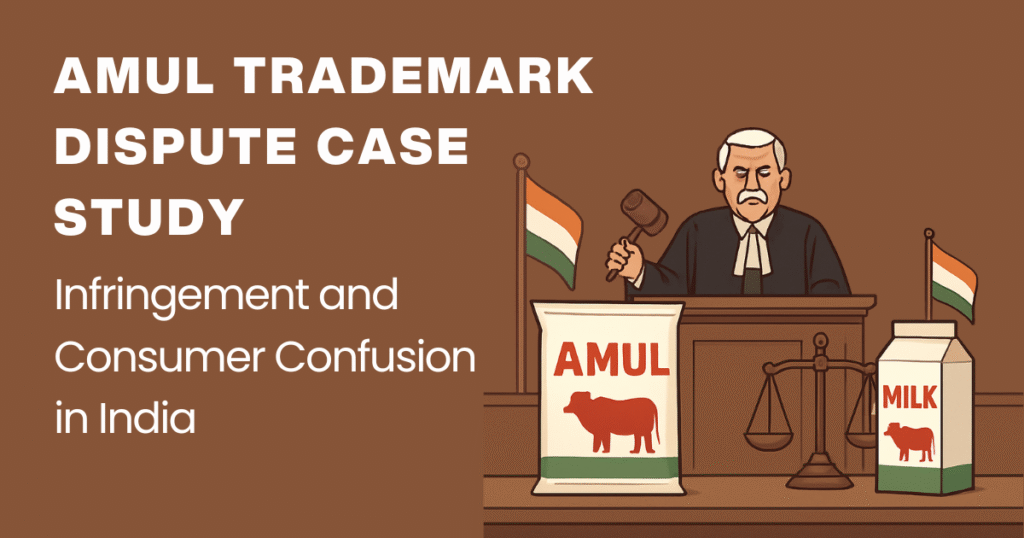
Introduction to the Amul Trademark Dispute
Amul represents one of India’s most trusted dairy brands.
Therefore, its trademark carries immense commercial and emotional value.
Over the decades, Amul built a strong brand recall nationwide.
Consequently, disputes involving its trademark attract serious legal attention.
This case study examines trademark infringement and consumer confusion issues.
Moreover, it highlights how Indian courts protect well-known marks.
Understanding Trademark Infringement in India
Trademark infringement occurs when an unauthorized party uses a similar mark.
As a result, consumers may assume a false association.
Indian trademark law prioritizes consumer protection and brand identity.
Therefore, courts assess visual, phonetic, and conceptual similarities.
Additionally, they examine the likelihood of confusion.
In contrast, honest concurrent use receives limited protection.
Background of the Amul Brand Identity
Amul operates under the Gujarat Cooperative Milk Marketing Federation.
Since inception, Amul positioned itself as a household staple.
Furthermore, its distinctive logo and typography ensure instant recognition.
The iconic Amul Girl advertising strengthened public association.
Thus, Amul achieved the status of a well-known trademark.
Consequently, it enjoys broader legal safeguards.
Nature of the Trademark Dispute
Several entities attempted to use deceptively similar marks.
For example, names mimicked “Amul” phonetically or visually.
Additionally, packaging resembled Amul’s trade dress.
As a result, consumers faced confusion at the point of purchase.
Therefore, Amul initiated legal proceedings to restrain misuse.
Meanwhile, defendants argued for descriptive or independent usage.
Key Legal Issues Considered by Courts
Courts examined the similarity between the contested marks.
Moreover, judges analyzed the nature of goods involved.
Since products belonged to similar dairy categories, risk increased.
Therefore, even minor similarities gained significance.
Additionally, courts evaluated Amul’s prior use and reputation.
Consequently, Amul’s goodwill played a decisive role.
Consumer Confusion and Market Impact
Consumer confusion formed the core issue.
When buyers mistake source identity, trust erodes quickly.
Thus, trademark law intervenes to preserve market fairness.
Furthermore, confusion damages both consumers and brand owners.
In contrast, clear differentiation benefits competitive markets.
Therefore, courts acted to prevent deceptive trade practices.
Court Findings and Judicial Reasoning
Indian courts favored Amul in most instances.
They recognized Amul as a well-known trademark.
Therefore, broader protection applied across product categories.
Moreover, intent to ride on Amul’s reputation became evident.
Consequently, injunctions restrained further unauthorized use.
Additionally, courts ordered changes in branding elements.
Implications for Indian Businesses
This case sends a strong message to businesses.
Brand imitation invites serious legal consequences.
Therefore, companies must conduct thorough trademark searches.
Moreover, originality in branding reduces litigation risks.
In contrast, shortcuts through imitation harm long-term growth.
Thus, proactive compliance supports sustainable brand building.
Lessons for Trademark Owners
Trademark owners should actively monitor market usage.
Early enforcement prevents dilution of brand value.
Furthermore, documentation of goodwill strengthens legal claims.
Therefore, consistent branding and advertising remain critical.
Additionally, timely legal action deters future infringements.
Overall, vigilance ensures trademark longevity.
Relevance to Digital and Modern Markets
Digital platforms increased exposure to brand misuse.
Consequently, online infringement cases are rising rapidly.
Therefore, trademark enforcement now extends to e-commerce platforms.
Moreover, social media amplifies consumer confusion quickly.
Thus, brands like Amul must protect digital identities.
Similarly, startups must secure trademarks early.
Conclusion: Strengthening Trademark Protection in India
The Amul trademark dispute highlights robust legal safeguards.
It reinforces the importance of consumer perception.
Therefore, Indian trademark law favors established goodwill.
Moreover, courts actively curb deceptive commercial practices.
As a result, brand trust remains protected in competitive markets.
Ultimately, this case strengthens confidence in India’s IP framework.