
November 21, 2026
By RVR Associates | Intellectual Property Rights
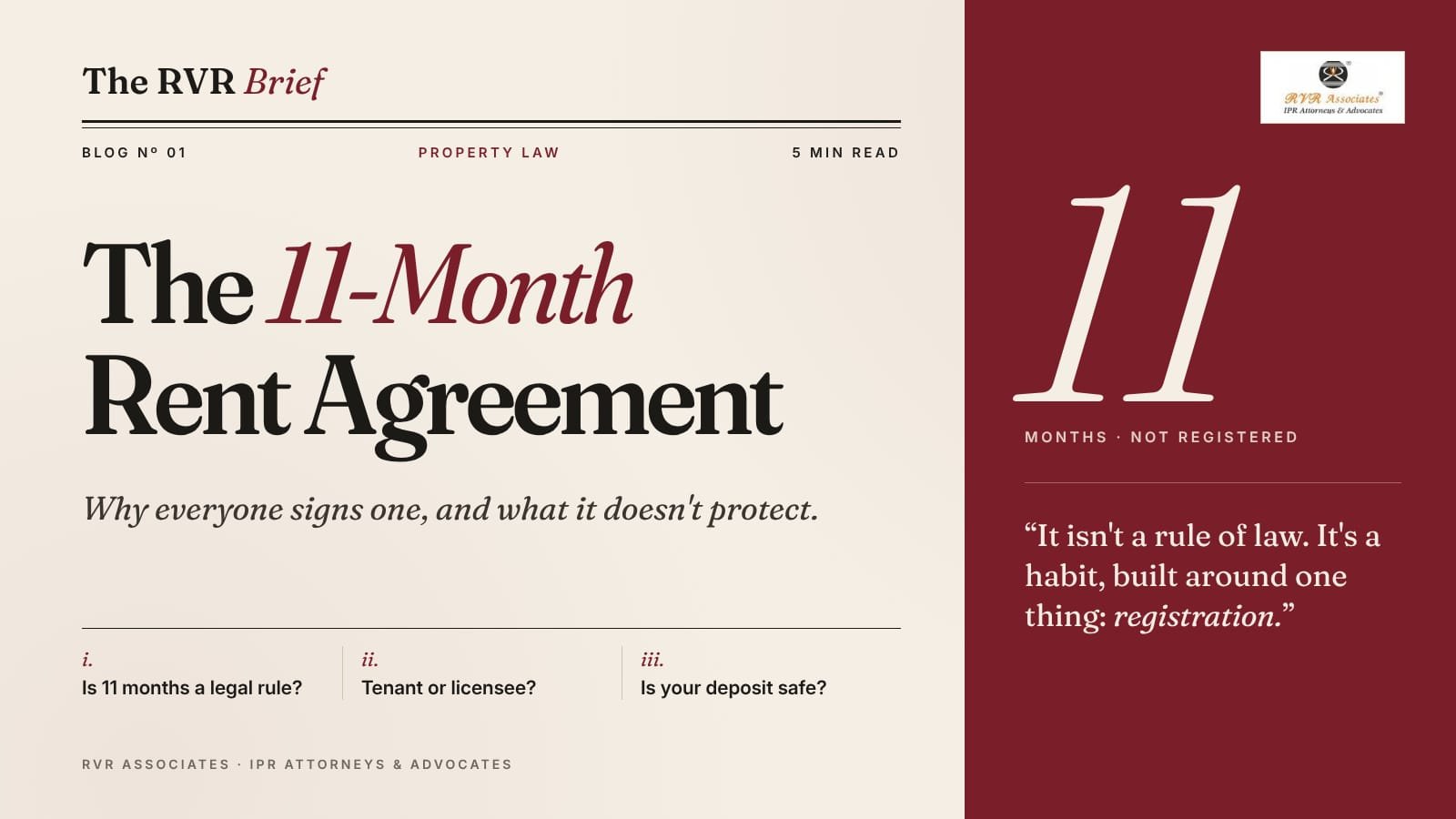
You found the flat. The owner hands you a printed agreement for 11 months, you sign on a stamp paper, pay the deposit and move in. Almost every renter in India has done this. But very few people know why it is 11 months, and what that piece of paper actually does for you.
Let’s clear up the most common beliefs, one at a time.
Myth 1: “11 months is a legal rule for rent agreements.”
Reality: There is no law that says a rent agreement must be 11 months. The number comes from the Registration Act, 1908. Under Section 17(1)(d), a lease of immovable property for any term exceeding one year must be compulsorily registered. Registration means a visit to the Sub-Registrar’s office, higher stamp duty and registration fees. An agreement of 11 months stays under one year, so most owners and tenants skip registration. It is a cost-saving habit, not a legal requirement.
Myth 2: “If I’ve signed a rent agreement, I’m a tenant.”
Reality: Read the title of your document. Many 11-month agreements are drafted as leave and licence agreements, not leases. That difference matters.
- A lease (Section 105, Transfer of Property Act, 1882) transfers a right to enjoy the property for a period.
- A licence (Section 52, Indian Easements Act, 1882) only gives you permission to use it. You get no interest in the property itself.
Courts don’t go by the label alone. In Associated Hotels of India Ltd. v. R.N. Kapoor (1959), the Supreme Court said the real test is the intention of the parties, seen from the whole document and the facts. Still, a document clearly drafted as a licence makes it harder for you to claim a tenant’s protections later.
Myth 3: “An unregistered agreement is useless in court.”
Reality: Not quite. Under Section 49 of the Registration Act, a document that should have been registered but wasn’t cannot be used to prove the lease itself. But it can still be used for a collateral purpose, such as proving how much deposit you paid or the nature of your possession. Keep your copy, your payment receipts and your bank transfer records safe.
Myth 4: “The stamp paper is just a formality.”
Reality: Stamp duty on rent agreements is set by each state’s stamp law. An agreement that is not properly stamped can be impounded when you try to rely on it, and you may have to pay the deficit duty with a penalty before a court will look at it. Spending a little on correct stamping now saves trouble later.
Myth 5: “My deposit is safe because it’s written in the agreement.”
Reality: The agreement is your proof, but getting the money back can still mean a fight. If the owner refuses to return the deposit without reason:
1. Send a written request first, by email or WhatsApp, so you have a record.
2. If that fails, send a legal notice through an advocate.
3. You can then file a civil suit to recover the amount.
The Model Tenancy Act, 2021 caps residential security deposits at two months’ rent, but it applies only in states that have adopted it, so check your state’s position.
Myth 6: “Renewing every 11 months changes nothing.”
Reality: Each renewal is a new agreement. The rent can go up, terms can change, and the owner can choose not to renew. Read every renewal as carefully as the first one, especially the notice period, the lock-in period and who pays for repairs.
So, what should you check before you sign?
- Is it a lease or a leave and licence?
- Is the stamp duty correct for your state?
- Are the deposit amount, refund timeline and deductions written down?
- Is there a lock-in period, and what happens if you leave early?
- Is the notice period the same for both sides?
- Who pays for maintenance, society charges and major repairs?
The 11-month agreement is convenient, and for most people it works fine. But convenience is not the same as protection. A few minutes of reading, and an advocate’s look when the stakes are high, can save you months of dispute.
References
1. Registration Act, 1908: Sections 17(1)(d) and 49
2. Transfer of Property Act, 1882: Section 105
3. Indian Easements Act, 1882: Section 52
4. Model Tenancy Act, 2021
5. Associated Hotels of India Ltd. v. R.N. Kapoor, AIR 1959 SC 1262
Author by,
RVR Attorneys Associates