
August 17, 2026
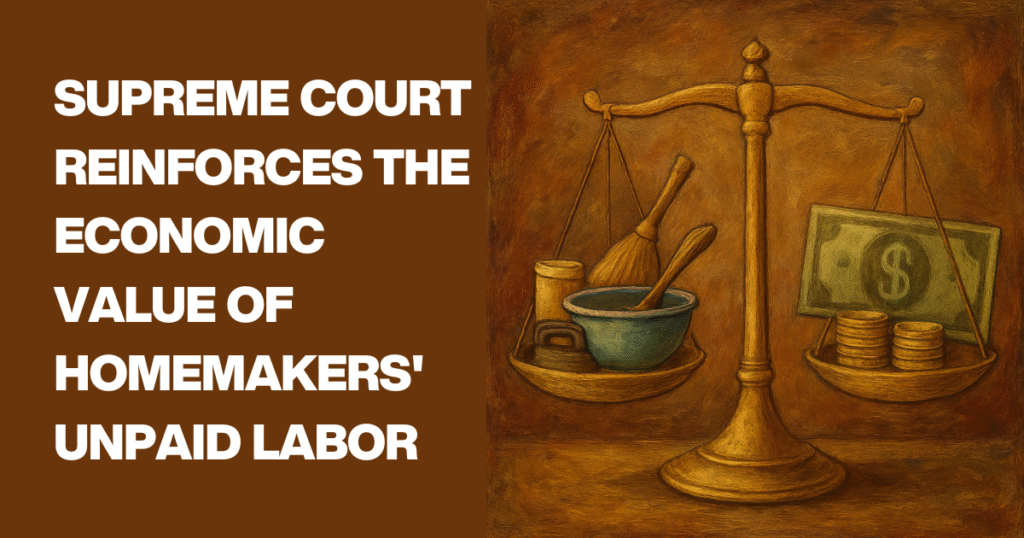
Supreme Court Reinforces the Economic Value of Homemakers' Unpaid Labor
For years, Indian courts have wrestled with an oddly specific but very real problem: how do you compensate a family when a homemaker dies in an accident, and she had no formal income to begin with? The numbers courts landed on were usually low, almost token, as if domestic labour barely counted as economic contribution at all. In June 2026, the Supreme Court decided that had to change.
The case behind it
It started with a road accident in Haryana back in November 2001, which killed a homemaker named Reshma. The Motor Accident Claims Tribunal awarded compensation, the Punjab and Haryana High Court revised it upward in 2024, and the family still wasn’t satisfied; they argued it still didn’t capture what Reshma had actually contributed to the household. The case reached the Supreme Court, and on June 11, 2026, a bench of Justice Sanjay Karol and Justice Nongmeikapam Kotiswar Singh delivered a ruling that went well past the facts of this one matter.
“Nation builders,” not just homemakers
The bench didn’t mince words on this: the term “homemaker” itself undersells what’s being described. The Court said these women should be understood as economic entities as nation builders, in its own phrasing, because raising children, running a household, and holding a family together are things with real economic weight, not just sentimental value nobody others to price.
A new head: “Loss of Domestic Care”
The concrete legal change here is the creation of a standalone compensation head called “Loss of Domestic Care.” What makes this significant is the separation it splits the actual economic labour of running a household (cooking, childcare, household management) from “loss of consortium,” which covers companionship and emotional loss. Before this, the two tended to blur together into one modest, fairly arbitrary figure.
The Court set a minimum notional value of ₹30,000 a month for this new head, with room to increase it over time. That replaces the patchwork of outdated notional income figures tribunals had been using for decades numbers that, in some older cases, sat as low as a few thousand rupees a month and barely moved even as everything else got more expensive.
The data behind the reasoning
The Court leaned on the National Statistical Office’s 2019 Time Use Survey, which found Indian women spend over seven hours a day on unpaid domestic work, a scale of labour the judgment said had gone systematically undervalued for far too long. Some estimates tied to the ruling put unpaid caregiving’s contribution to India’s GDP somewhere between 15% and 17%, if anyone actually counted it.
Fixing delays too
Alongside the substantive change, the Court flagged how badly motor accident litigation drags on, with appeals pending an average of around eight years in some cases, and directed High Court Chief Justices to prioritise the oldest matters and expand dedicated benches. A better compensation formula doesn’t mean much if claimants are waiting a decade to see it.
Why this reaches beyond one accident case
Technically, this ruling is confined to compensation calculations under the Motor Vehicles Act. But it builds on years of courts gesturing toward this recognition without ever formalizing it into something quantifiable. Now there’s an actual number, and a mandate for tribunals to apply it consistently, which gives future litigants, and honestly policymakers too, something concrete to point to.
Worth being precise about what it doesn’t do: it doesn’t create wages for domestic work, and it doesn’t turn homemaking into formal employment with labor law protections attached. Its reach stays within compensation law. But by putting a real figure on unpaid domestic labor and insisting courts actually use it, the Supreme Court has closed a gap that’s sat there, mostly ignored, for a very long time.
Author by,
RVR Attorneys Associates