
August 7, 2026
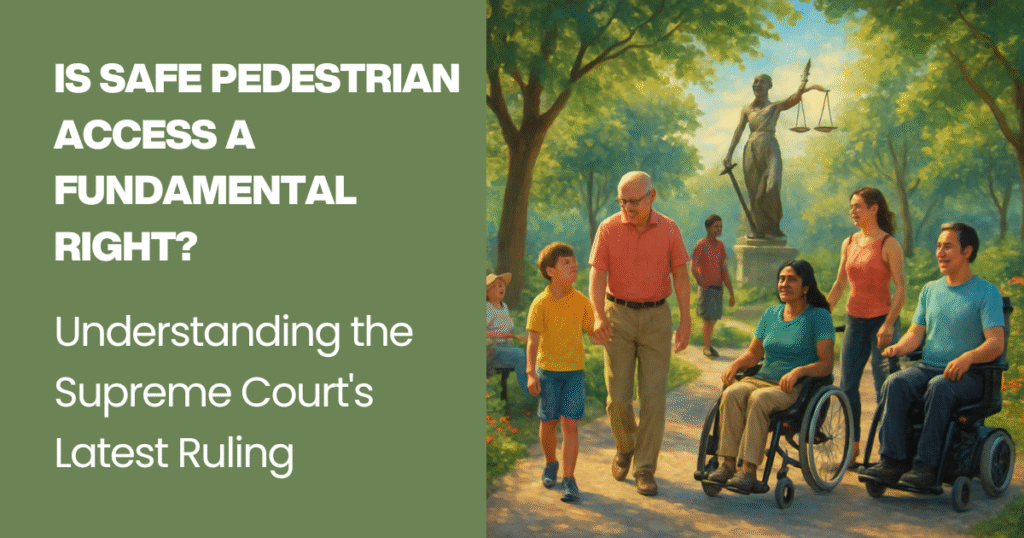
Is Safe Pedestrian Access a Fundamental Right? Understanding the Supreme Court's Latest Ruling
Anyone who’s tried to walk anywhere in an Indian city knows the drill: footpaths that vanish into parked cars, construction rubble, or just nothing at all, forcing you onto the road with traffic. In June 2026, the Supreme Court decided this wasn’t just bad urban planning anymore. It’s a constitutional problem.
Where the case came from
The judgment came down on June 19, 2026, from a bench of Justices P.S. Narasimha and A.S. Chandurkar, and it grew out of what started as a fairly routine motor accident compensation dispute involving the death of a five-year-old child. The Court used that tragedy as the entry point into something much bigger: a constitutional conversation about pedestrian safety and how Indian cities are built, or aren’t, for people on foot.
What the Court actually said
The reasoning rests on two constitutional provisions working together: Article 19(1)(d), the freedom to move throughout Indian territory, and Article 21, the right to life. The logic: freedom of movement means nothing if it doesn’t extend to the most basic form of movement there is: walking, and that freedom has to be safe, not just theoretical.
What stands out is how directly the Court ranked pedestrians above vehicles. It called out Indian urban planning for consistently favouring cars and two-wheelers over people walking, and framed footpaths as essential infrastructure, not some optional nicety cities get around to eventually.
Not entirely out of nowhere
This wasn’t the Court’s first move here. About a year earlier, it had already told the central government and states to draft guidelines for accessible, obstruction-free footpaths, specifically calling out the needs of people with disabilities and noting that missing footpaths directly cause accidents. The 2026 ruling takes those earlier administrative directions and turns them into an actual fundamental rights declaration.
What comes next
The Court has kept this case open rather than closing it out with a continuing mandamus, in legal terms, and has directed several Union ministries, including Housing and Urban Affairs, Rural Development, and Road Transport, to work toward a proper statutory framework. The Law Commission has been pulled in too, tasked with defining exactly what obligations states and local bodies owe pedestrians, and what remedies citizens actually have when those obligations go unmet.
This matters because declaring a fundamental right doesn’t fix a broken footpath by itself. The Court seems to know that, which is presumably why it’s structured this to keep tracking compliance rather than issue one ruling and walk away.
The numbers behind the urgency
Government data puts pedestrian deaths at over 36,000 in a recent year, more than a fifth of all road fatalities in the country. Illegal parking, construction debris, and random unauthorized structures remain the everyday obstacles making that possible.
What this means for cities
For municipal corporations and state governments, this ruling turns pedestrian infrastructure from a nice-to-have into a binding constitutional obligation. Road design decisions, parking and vending licences, infrastructure budgets all of it may now need to account for this, especially since the Court has made clear it plans to actually supervise how this plays out.
The bigger picture
This fits a pattern the Supreme Court’s been building for a while, stretching Article 21 to cover the everyday stuff: clean air, safe water, and now, safe walking. Whether this actually produces walkable Indian cities depends on how seriously ministries and municipal bodies take it over the coming months. But constitutionally, the point’s been made: the right to move includes the right to walk, and that walk has to be safe.
Author by,
RVR Attorneys Associates