
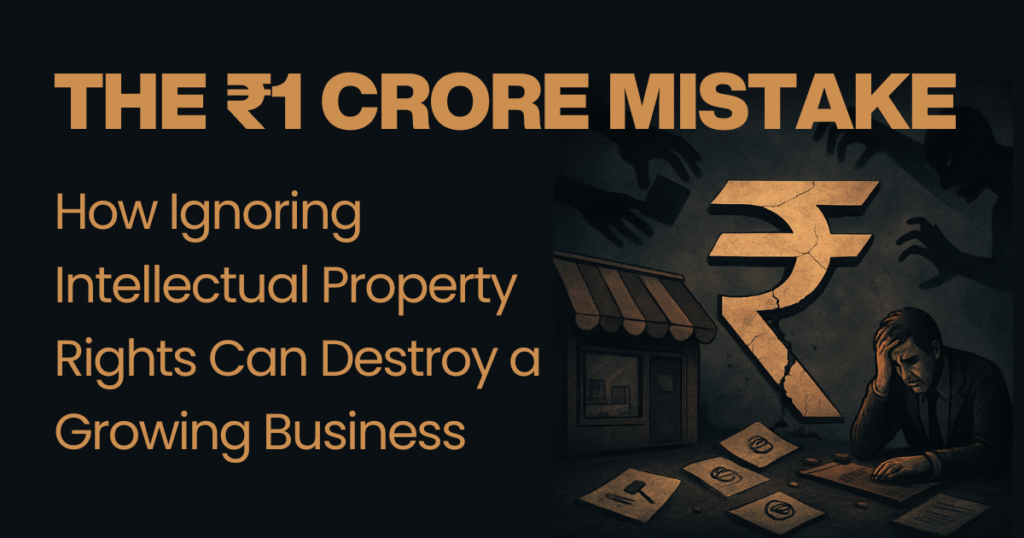
Imagine building a successful business from the ground up.
You spend years developing products, attracting customers, investing in marketing, hiring employees, and expanding into new markets. Revenue grows, investors show interest, and your brand starts gaining recognition.
Then, without warning, a legal notice arrives.
A competitor claims ownership of your brand name.
A former employee disputes ownership of critical software code.
A rival launches a copycat product because your innovation was never protected.
Within months, legal costs, lost sales, and rebranding expenses begin piling up.
For many businesses, the financial impact can easily exceed ₹1 crore.
This is the hidden cost of ignoring Intellectual Property Rights (IPR).
While many entrepreneurs focus on growth strategies, funding, and operations, intellectual property protection often gets pushed aside until a problem emerges. Unfortunately, by then, the damage can be expensive and difficult to reverse.
Why Intellectual Property Is a Business Asset
Intellectual property is often one of the most valuable assets a company owns.
It includes:
- Brand names
- Logos
- Patents
- Copyrights
- Product designs
- Trade secrets
- Software code
- Proprietary business processes
These assets help businesses differentiate themselves from competitors.
More importantly, they create long-term value.
Companies that actively protect intellectual property are often better positioned to attract investors, secure partnerships, and expand into new markets.
Many Businesses Underestimate the Value of Their Ideas
A common misconception among startups and small businesses is that intellectual property protection is only necessary for large corporations.
In reality, smaller businesses may be even more vulnerable.
Without legal protection, a competitor can copy years of work and enter the market with minimal investment.
What took one company years to build can be replicated surprisingly quickly.
The Real Cost of Ignoring Intellectual Property Rights
The financial consequences of poor intellectual property management can be severe.
Many businesses only recognize the importance of IPR after experiencing a costly setback.
Here are some of the most common consequences.
1. Forced Rebranding Costs
If another company secures trademark rights to a name similar to yours, you may be required to rebrand.
This often involves:
- New logos
- Website redevelopment
- Updated packaging
- Marketing campaigns
- Customer communication efforts
The direct and indirect costs can be substantial.
2. Lost Market Share
When innovations are not protected through patents, copyrights, or trade secrets, competitors can introduce similar products.
This can reduce your competitive advantage and erode market share.
3. Expensive Legal Disputes
Intellectual property litigation is often time-consuming and costly.
Businesses may face:
- Attorney fees
- Court expenses
- Settlement payments
- Operational disruptions
In many cases, preventive protection costs far less than resolving disputes.
4. Reduced Investor Confidence
Investors increasingly examine intellectual property portfolios before making funding decisions.
Weak IP protection may raise concerns about scalability, defensibility, and long-term value creation.
The Most Common IPR Mistakes Businesses Make
Many costly intellectual property problems can be traced back to a few preventable mistakes.
Delaying Trademark Registration
Businesses often launch products and marketing campaigns without securing trademark rights.
This creates opportunities for competitors to register similar marks.
Failing to Patent Valuable Innovations
Innovative technologies, processes, and product improvements may qualify for patent protection.
Delaying patent filings can result in lost opportunities.
Ignoring Copyright Ownership
Businesses frequently outsource content creation, software development, or design work.
Without proper agreements, ownership disputes can arise later.
Neglecting Employee and Contractor Agreements
Employees and freelancers often contribute to intellectual property creation.
Clear ownership provisions are essential to avoid future conflicts.
Poor Documentation Practices
Businesses that fail to document innovation processes may struggle to prove ownership during disputes.
How Strong IPR Protection Supports Business Growth
Intellectual property is more than a legal safeguard.
It is a growth strategy.
Well-protected intellectual property can:
- Increase business valuation
- Strengthen brand recognition
- Improve investor appeal
- Support licensing opportunities
- Create barriers for competitors
- Enhance customer trust
Companies with strong intellectual property portfolios often enjoy greater flexibility when expanding domestically and internationally.
Intellectual Property Creates Competitive Advantage
In highly competitive industries, products can often be copied.
Strong intellectual property protection helps ensure that innovation remains a unique business advantage rather than a public resource for competitors.
This protection becomes increasingly valuable as a business scales.
Practical Steps to Protect Your Business
Every business should consider implementing the following measures:
- Register trademarks early.
- Evaluate patent opportunities regularly.
- Secure copyright ownership through contracts.
- Use confidentiality agreements.
- Protect trade secrets internally.
- Maintain detailed innovation records.
- Conduct regular intellectual property audits.
- Monitor infringement actively.
These steps can significantly reduce risk while preserving the value of business assets.
Prevention Costs Less Than Recovery
Many businesses spend years recovering from intellectual property disputes.
By comparison, proactive intellectual property management requires relatively modest investments and provides long-term protection.
The most successful companies treat intellectual property as a strategic asset rather than a legal afterthought.
Conclusion
The ₹1 crore mistake is not a single decision.
It is often the result of repeatedly ignoring intellectual property protection while focusing solely on growth.
Trademark disputes, patent conflicts, copyright issues, and trade secret leaks can quickly undermine years of hard work.
The good news is that most intellectual property risks are preventable.
Businesses that prioritize IPR protection early can safeguard innovation, strengthen competitive advantages, attract investment, and build sustainable long-term value.
In today’s knowledge-driven economy, protecting your ideas is just as important as creating them.
Frequently Asked Questions
What are Intellectual Property Rights (IPR)?
IPR are legal protections that safeguard creations such as inventions, trademarks, copyrights, designs, and trade secrets.
Why are Intellectual Property Rights important for businesses?
They help protect innovation, prevent unauthorized use, strengthen competitive advantages, and increase business value.
Can a startup benefit from intellectual property protection?
Yes. Strong intellectual property protection can improve investor confidence, support growth, and reduce legal risks.
What is the biggest IPR mistake businesses make?
Delaying trademark registration and failing to identify protectable intellectual property assets are among the most common mistakes.
How can businesses protect their intellectual property?
By registering trademarks, filing patents where applicable, securing copyrights, using confidentiality agreements, and conducting regular IP audits.
Author by,
Ananthakesavan V,
Advocate – IPR & Litigation
RVR Associates, IPR Attorneys and Advocates